Address
Kerala, India.
Made with ❤️ to make learning and exam preparation a little easier.
Address
Kerala, India.
Made with ❤️ to make learning and exam preparation a little easier.

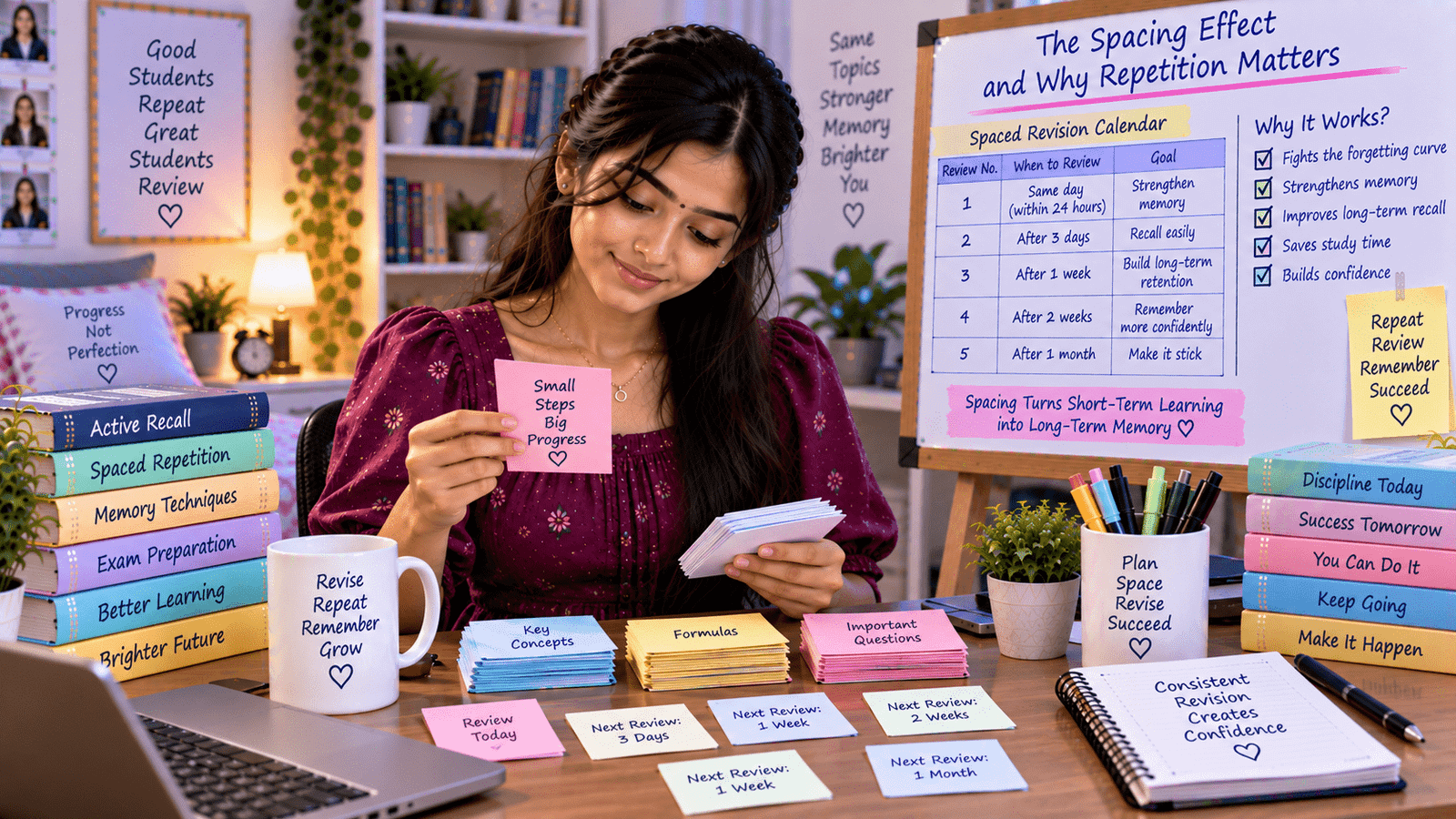
Students often try to learn large amounts of information in a single study session. While concentrated study can be useful for some tasks, spreading learning across multiple sessions can support longer-term retention. This idea is known as the Spacing Effect.
The spacing effect refers to the finding that learning can be more effective when study sessions are separated over time rather than packed into one continuous session. Instead of studying a topic for several hours once, students can revisit it across multiple days or weeks.
When you return to information after some time has passed, you have to retrieve it again. This creates an opportunity to strengthen your ability to recall the material. Each review also gives you a chance to identify information that has become difficult to remember.
Simply repeating information many times in a short period is not the same as spaced practice. The benefit comes from creating intervals between learning sessions.
For example, instead of reading the same chapter five times in one evening, you might study it once and revisit the key concepts on several different days.
The technique can be adapted to many subjects. Language learners can revisit vocabulary regularly. Mathematics students can return to different problem types. Science students can repeatedly recall definitions, processes, and diagrams.
There is no need to create an overly complicated timetable. Mark important topics in your planner and schedule multiple review sessions before the examination. Topics that are difficult to remember can be reviewed more frequently.
Spacing becomes particularly useful when combined with active recall. During each review, try to remember the information before checking your notes.
The Spacing Effect shows why repetition can be more useful when it is spread across time. Instead of trying to remember everything in one long session, give yourself multiple opportunities to retrieve the information. This can make your revision more consistent and purposeful.