Address
Kerala, India.
Made with ❤️ to make learning and exam preparation a little easier.
Address
Kerala, India.
Made with ❤️ to make learning and exam preparation a little easier.

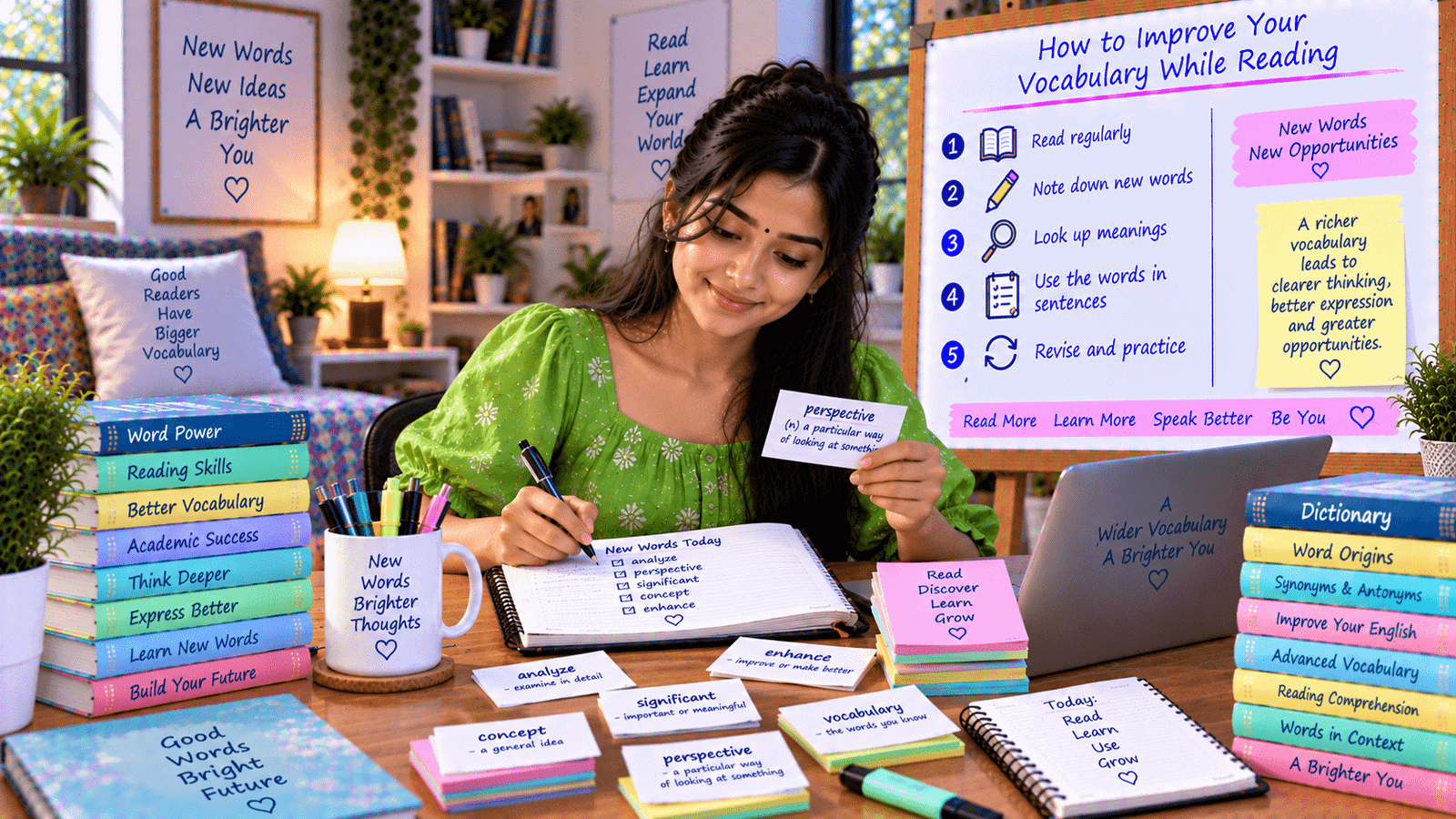
Reading is one of the most natural ways to encounter new words. Textbooks, articles, stories, newspapers, and educational resources can introduce vocabulary in meaningful contexts. Instead of trying to memorize long lists of unrelated words, students can build vocabulary gradually by paying attention to words encountered during regular reading.
When you encounter an unfamiliar word, do not automatically skip it. First, consider whether the surrounding sentence gives you clues about its meaning.
Look at the words and sentences around an unfamiliar term. Definitions, examples, comparisons, and descriptions may help you understand the meaning without immediately using a dictionary.
If the meaning remains unclear, use a reliable dictionary or educational reference. Check not only the definition but also pronunciation, word type, and example usage when helpful.
Keep a vocabulary notebook or digital list for important new words. Write the word, its meaning, and an example sentence. Learning a word in context can make it easier to understand how it is actually used.
Try using new vocabulary when writing answers, summaries, or explanations. Active use can help turn a word from something you recognize into something you can confidently use.
Return to previously learned words periodically. You can create simple flashcards or test yourself by covering the meanings and trying to recall them.
Reading across different subjects exposes you to different styles of language. Science, history, literature, and general educational writing may each introduce different vocabulary.
Vocabulary growth is a gradual process. Read regularly, use context clues, check unfamiliar words, record useful vocabulary, practice using new terms, and review them periodically.