Address
Kerala, India.
Made with ❤️ to make learning and exam preparation a little easier.
Address
Kerala, India.
Made with ❤️ to make learning and exam preparation a little easier.

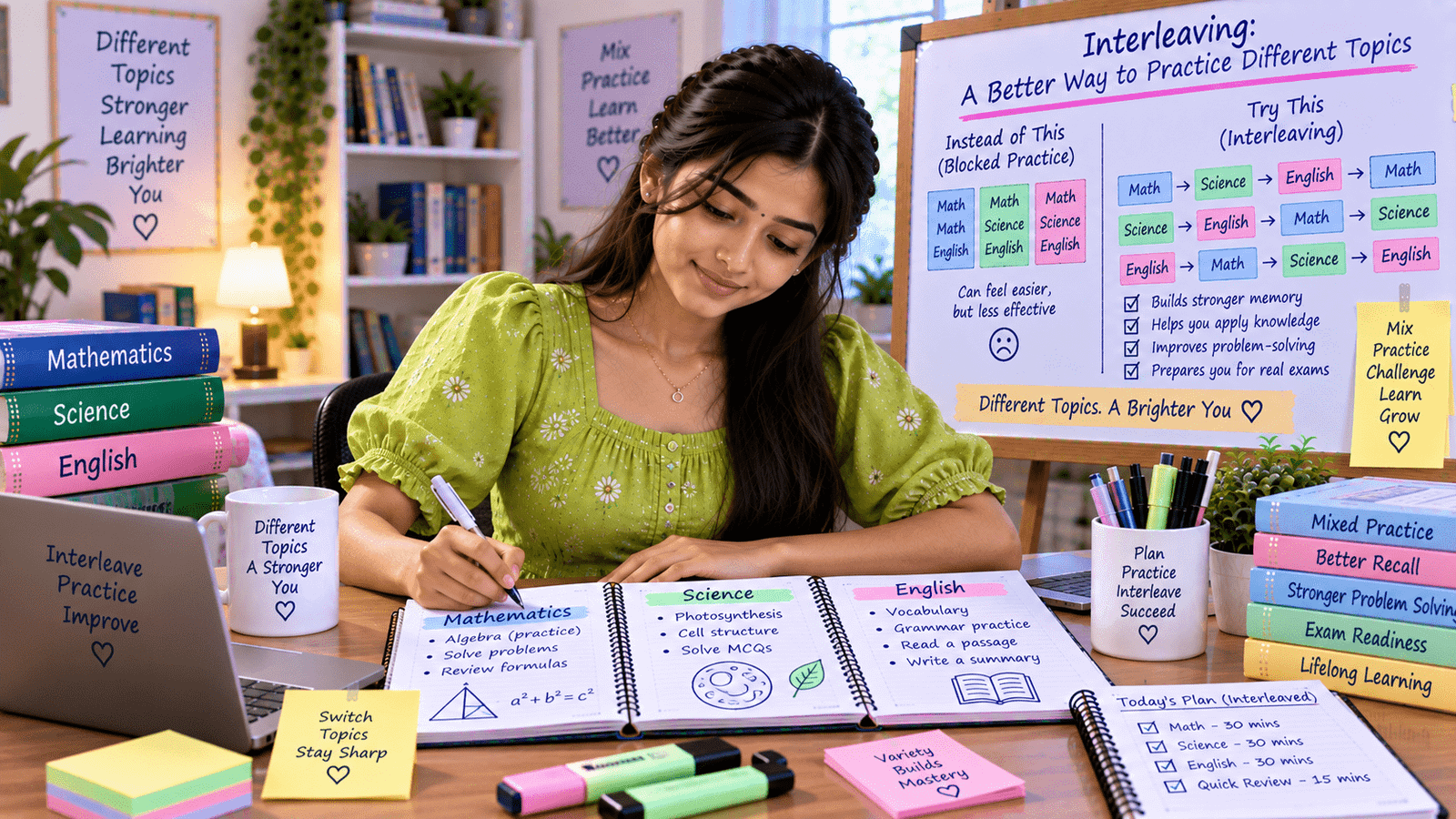
Students often practice one topic repeatedly before moving to another. While this approach can feel comfortable, mixing different topics or problem types can sometimes create more useful practice. This learning strategy is known as interleaving.
Interleaving means alternating between different topics, skills, or types of problems during practice. Instead of completing twenty questions of exactly the same type, you might work on several different types in one study session.
Blocked practice means focusing on one type of task at a time. For example, a mathematics student might solve ten problems using the same formula before moving to another formula.
With interleaving, different problem types are mixed together. This requires the student to decide which method or concept should be used for each question.
Interleaving encourages students to identify differences between problems. Instead of automatically repeating the same procedure, you need to determine what type of problem you are facing and select an appropriate strategy.
Interleaving may be easier to use after you have learned the basic skills involved. If a concept is completely new, some initial focused practice can help you understand it before mixing it with other topics.
In mathematics, mix different problem types. In language learning, alternate vocabulary, grammar, reading, and writing practice. In science, combine questions from different chapters rather than practicing only one chapter at a time.
Interleaving can make practice feel more difficult because you cannot simply repeat the same method. However, that challenge can encourage deeper thinking. Once you understand the basics, mixing related topics can help you practice choosing the right strategy for different questions.