Address
Kerala, India.
Made with ❤️ to make learning and exam preparation a little easier.
Address
Kerala, India.
Made with ❤️ to make learning and exam preparation a little easier.

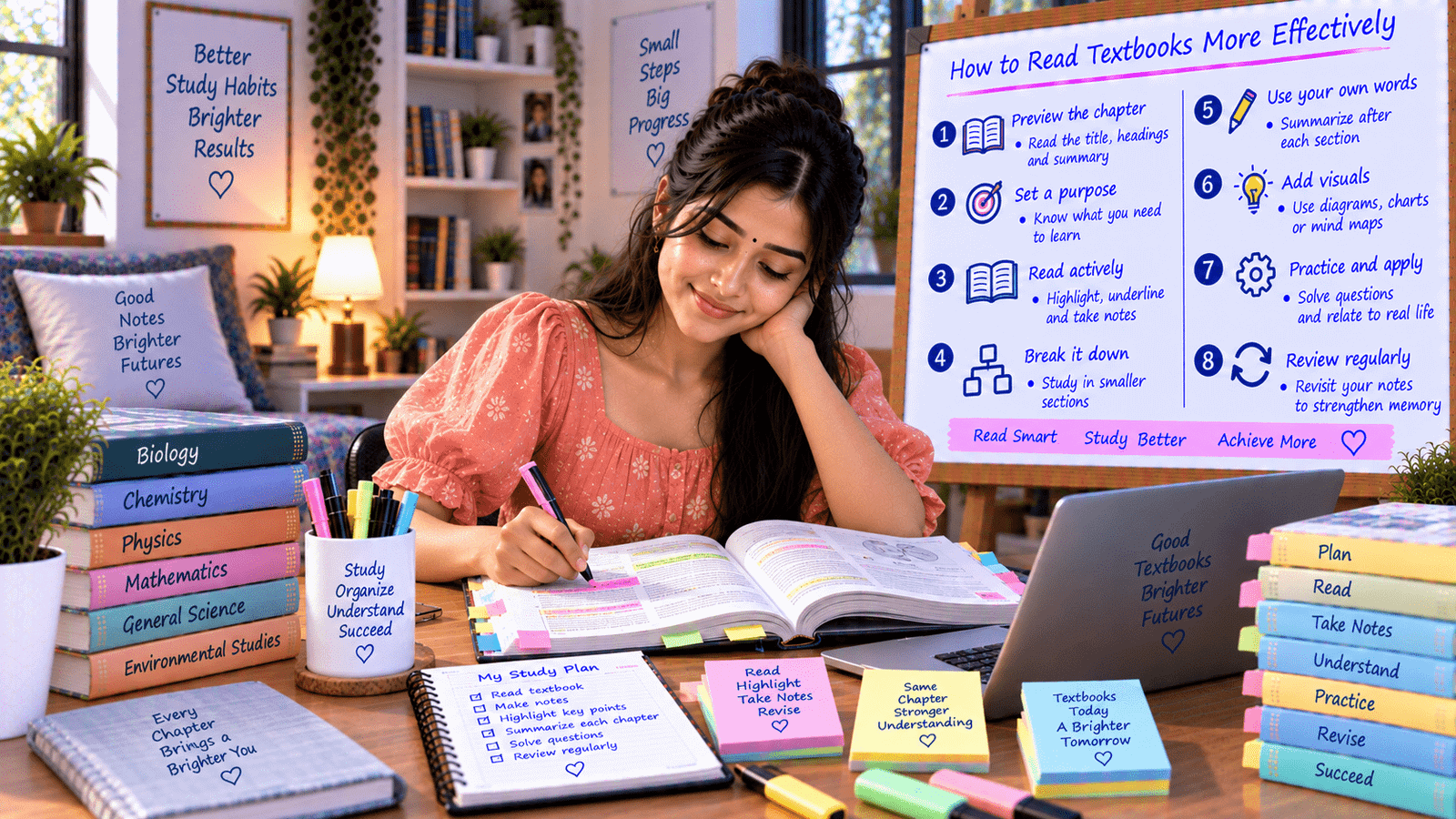
Textbooks contain detailed information, explanations, examples, diagrams, and exercises, but reading them from the first page to the last without a strategy is not always the most effective way to study. A structured approach can help you understand important concepts while using your study time efficiently.
Before reading every paragraph, look at the chapter title, headings, subheadings, diagrams, tables, summaries, and review questions. This gives you an overview of the material.
Convert important headings into questions. If a heading says “Causes of Soil Erosion,” ask yourself, “What are the causes of soil erosion?” Then read the section while looking for the answer.
Think about the information as you read. Identify important ideas, connect new concepts with previous knowledge, and mark questions that you need to investigate further.
Do not copy entire textbook pages into your notebook. Record key definitions, concepts, formulas, relationships, and examples in your own words.
Textbooks often contain visual explanations that summarize complicated information. Study these carefully and try explaining what they show without looking at the accompanying text.
Close the textbook and recall the main ideas. Try answering the questions you created earlier. This turns textbook reading into an active learning process.
At the end of a chapter, use the summary and review questions to check your understanding. Return to sections where your knowledge is weak.
Effective textbook reading is active and purposeful. Preview the chapter, ask questions, identify important ideas, take selective notes, study visuals, and test yourself after reading.