Address
Kerala, India.
Made with ❤️ to make learning and exam preparation a little easier.
Address
Kerala, India.
Made with ❤️ to make learning and exam preparation a little easier.

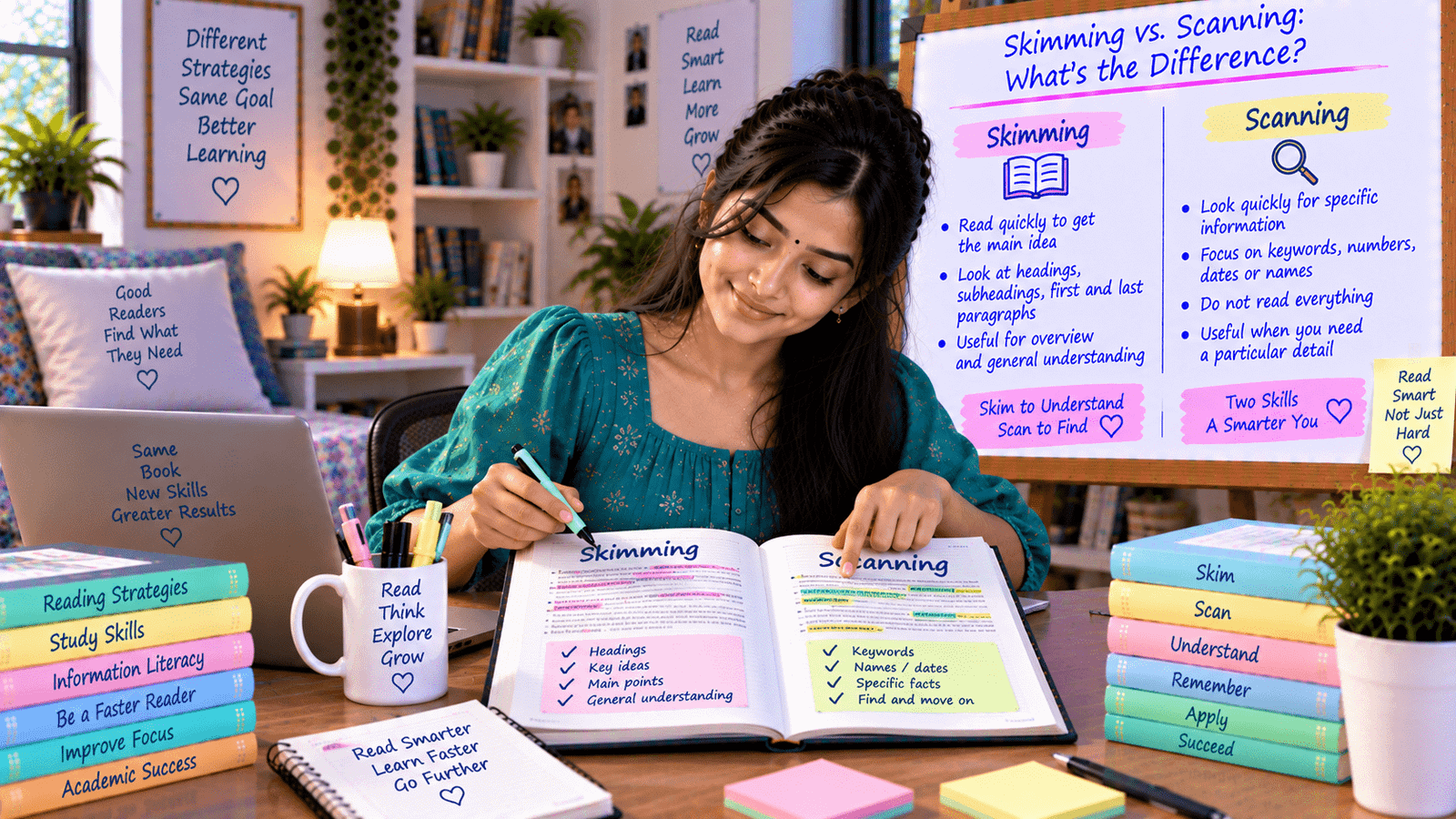
Skimming and scanning are two reading techniques that help you find or understand information quickly. Although the terms are sometimes used interchangeably, they serve different purposes. Knowing when to skim and when to scan can make reading textbooks, articles, documents, and study materials more efficient.
Skimming means reading quickly to understand the general idea or structure of a text. Instead of reading every sentence carefully, you focus on titles, headings, introductory sentences, keywords, summaries, and other important parts.
For example, you might skim a chapter before studying it in detail to understand what topics it covers.
Scanning means moving through a text to find a specific piece of information. You already know what you are looking for and search for a particular word, number, name, date, or phrase.
For example, you might scan a timetable to find the starting time of an examination.
Skimming is useful when you want an overview before detailed reading. It can also help you decide whether a document contains information relevant to your purpose.
Scanning is useful when you need one specific detail. It saves time because you do not need to read the entire document from beginning to end.
Skimming and scanning are useful for specific purposes, but they should not replace careful reading when you need to understand complex material. Use the reading technique that matches your purpose.
Skimming helps you understand the general structure and main ideas of a text, while scanning helps you locate specific information. Learning to use both techniques can make your reading more flexible and efficient.