Address
Kerala, India.
Made with ❤️ to make learning and exam preparation a little easier.
Address
Kerala, India.
Made with ❤️ to make learning and exam preparation a little easier.


Effective studying is not simply about spending more hours with a textbook. Research on learning and memory has identified several principles that can help students make better use of their study time. Understanding these principles can help you replace ineffective habits with more purposeful strategies.
One important lesson from learning science is the value of retrieving information from memory. Instead of repeatedly reading your notes, ask yourself questions and try to answer them without looking.
Practice remembering, not just recognizing. This can make your study sessions more similar to the demands of an actual examination.
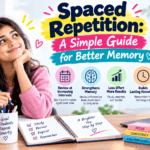
Learning can benefit from being distributed across multiple sessions. Returning to information after some time has passed creates additional opportunities to retrieve it. This is why regular revision can be more useful than relying entirely on one long study session.
Tests and practice questions do more than measure knowledge. They can reveal what you remember, expose gaps, and give you experience retrieving information. Use practice questions throughout your preparation rather than only at the end.
Interleaving different topics or problem types can encourage you to think about which method is appropriate for each task. This can be particularly useful after you have learned the basic skills involved.
Learning becomes difficult when too much unfamiliar information is presented at once. Break complex subjects into manageable sections and reduce unnecessary distractions. Build new knowledge on top of concepts you already understand.
Some study methods feel harder because they require more mental effort. Trying to recall an answer without looking at your notes can be more demanding than rereading it. Appropriate challenges can make learning more active.
Mistakes provide useful information about what you need to improve. When you answer a question incorrectly, find out why, review the relevant concept, and try again. Avoid treating mistakes only as failures.
No single learning technique is perfect for every situation. A strong study routine can combine understanding new material, active recall, spaced revision, practice questions, problem-solving, and rest.
Learning science provides several practical lessons for students: retrieve information actively, space your revision, practice with questions, manage cognitive load, and use mistakes as feedback. Effective studying is less about simply increasing study hours and more about using those hours deliberately.